I get so addicted to vibecoding that I forget to think
I built 18 features, designed branding, generated 200+ images, made an algorithm, landing page, blog posts. And I learned from a 30-second comment that nobody wanted it.
I showed my app to Martin, a backpacker friend and the perfect target for my new side project. He didn’t understand one bit. I explained how it works, what it does, why it’s useful. No reaction. He didn’t see any value in this project.
I had built 18 features, designed the full branding, generated 200+ images, made a gear algorithm, shipped a TestFlight, written a landing page and blog posts for SEO. I spent weeks building with AI. And I had learned from a 30-second conversation that I was solving a problem that doesn’t exist.
Here’s the idea: I love the outdoors, I love design, so why not build an outdoor app? I called it Alpine Index. You tell the app where you’re going, when, and what kind of trip. It generates a beautiful collection of gear tiles as a checklist, so you know exactly what to pack. Super simple!
Here’s what I actually built:
- A SpriteKit physics engine for tile animations in a checklist app
- A voice creation flow with transcription
- An LLM integration calling GPT-4o-mini
- A journal system with guided prompts
- A “Living Page” with letter-by-letter reveal animations and floating cards
- A conversation AI with keyword widgets
- A weather service integration
- A photo capture and processing pipeline
- A Gear Garage canvas view
- A CSV import system with column mapping
- A celebration manager
- A wildflower decoration component
- 52 individual HTML pages for trail-specific checklists
- 52 matching Instagram slideshow pages
- An Instagram carousel PNG export script
- A gear guide section
- A trail finder tool
- 200+ AI-generated item images
I can’t believe I’m writing this. None of these features were useful, not even one.
So how did I get here? I’m a senior product designer and I’ve worked in tech for over 10 years. I know my basics: never build before validating product-market fit. It was even written in my own AI-generated product doc: “Validate with 200+ waitlist signups and 8+ enthusiastic interviews before committing.” I read that line and agreed with it, then I switched tabs and I built a physics engine.
For someone who doesn’t code but loves building, AI feels like cocaine. All my ideas felt genius because AI told me they were. AI said yes to everything, building features in minutes instead of days. And like cocaine, AI is addictive. So at a certain point, I stopped asking “Should I?” and kept building. I thought, let me implement first and see, then ended up spending days fixing bugs and polishing details on features I never questioned.
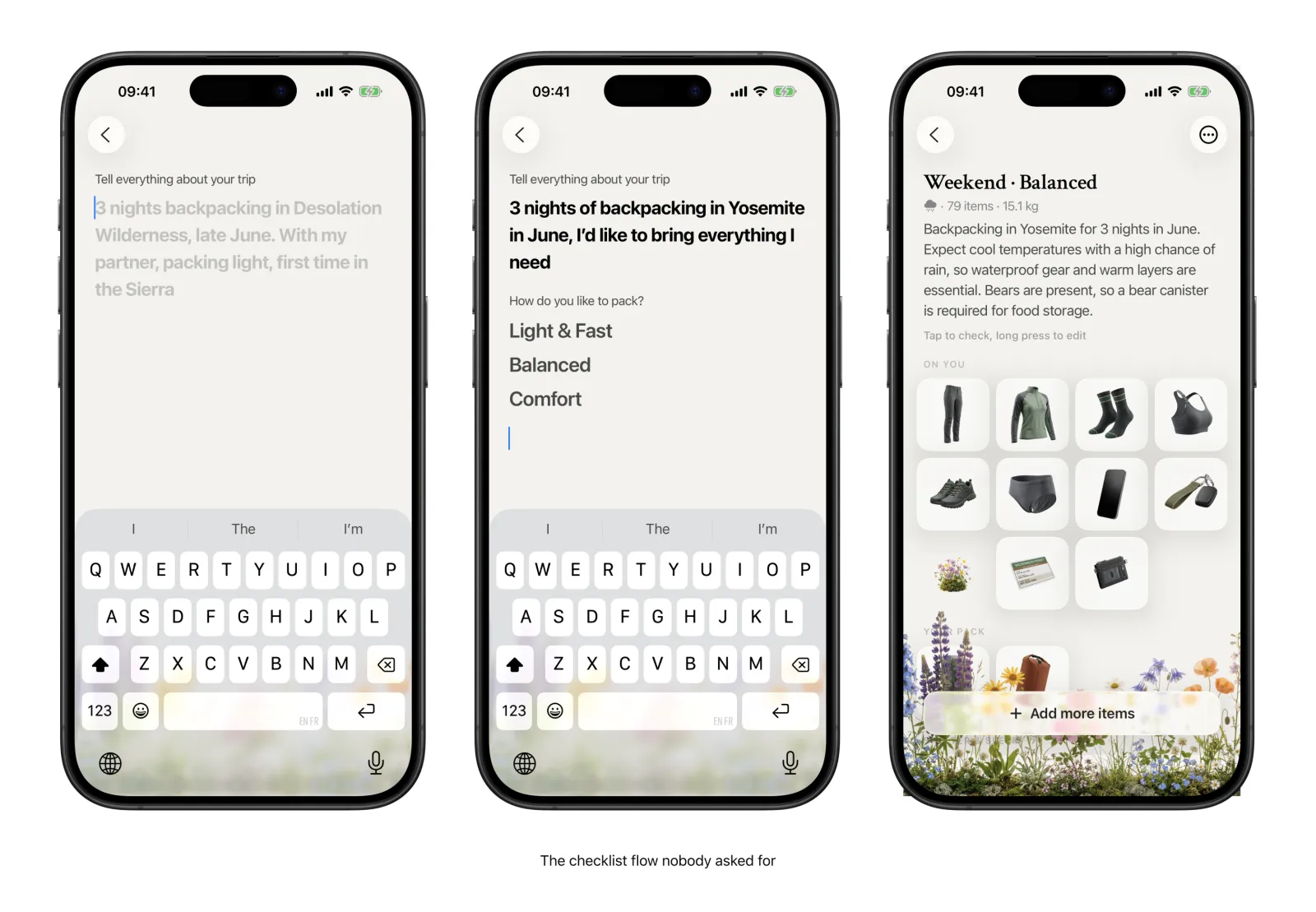
I also thought design could save the product. As a designer, vibecoding lets you build any visual you’ve ever dreamed of. So I spent hours crafting prompts and building an image generation pipeline to create beautiful gear tiles. Tiles that people either didn’t care about or didn’t recognize.
But here’s the thing that bothers me most: does this even need to be an app? What I love about the outdoors is being outside. Without any screens, notifications, or distractions. Building an app to help people go outside is like offering steak to a vegan person. If I really wanted to help people pack for trips, a nice checklist notebook they keep in their backpack would probably have more impact than another app in the App Store. But because I felt excited by the tech capabilities of AI, I built another app people don’t need.
I got so mad about all of this that I built something actually useful: a Claude skill that tells you when your idea is bad. You type /roast, paste your concept, and it pressure-tests it with no mercy. If the idea is weak, it says so.
Here’s what it said about my project:
The people who pack a lot already know what they bring, and the people who don’t pack often don’t care enough to download an app for it.
You’re building for a 15-minute task that happens 6 times a year - and competing against a note that already works.
You spent too long building because building felt like progress.
The app has more content marketing pages than core app screens. It doesn’t have users yet, but it has SEO-optimized checklists for Kilimanjaro.
Since then, I use /roast for almost everything. And it feels so good to finally have an AI to disagree with me. But the fact that I had to build a skill to get honest feedback from AI is definitely not a good signal.
Building is so easily mistaken for progress.